
The Life and Death of Nathan Hale
September 22, 2026
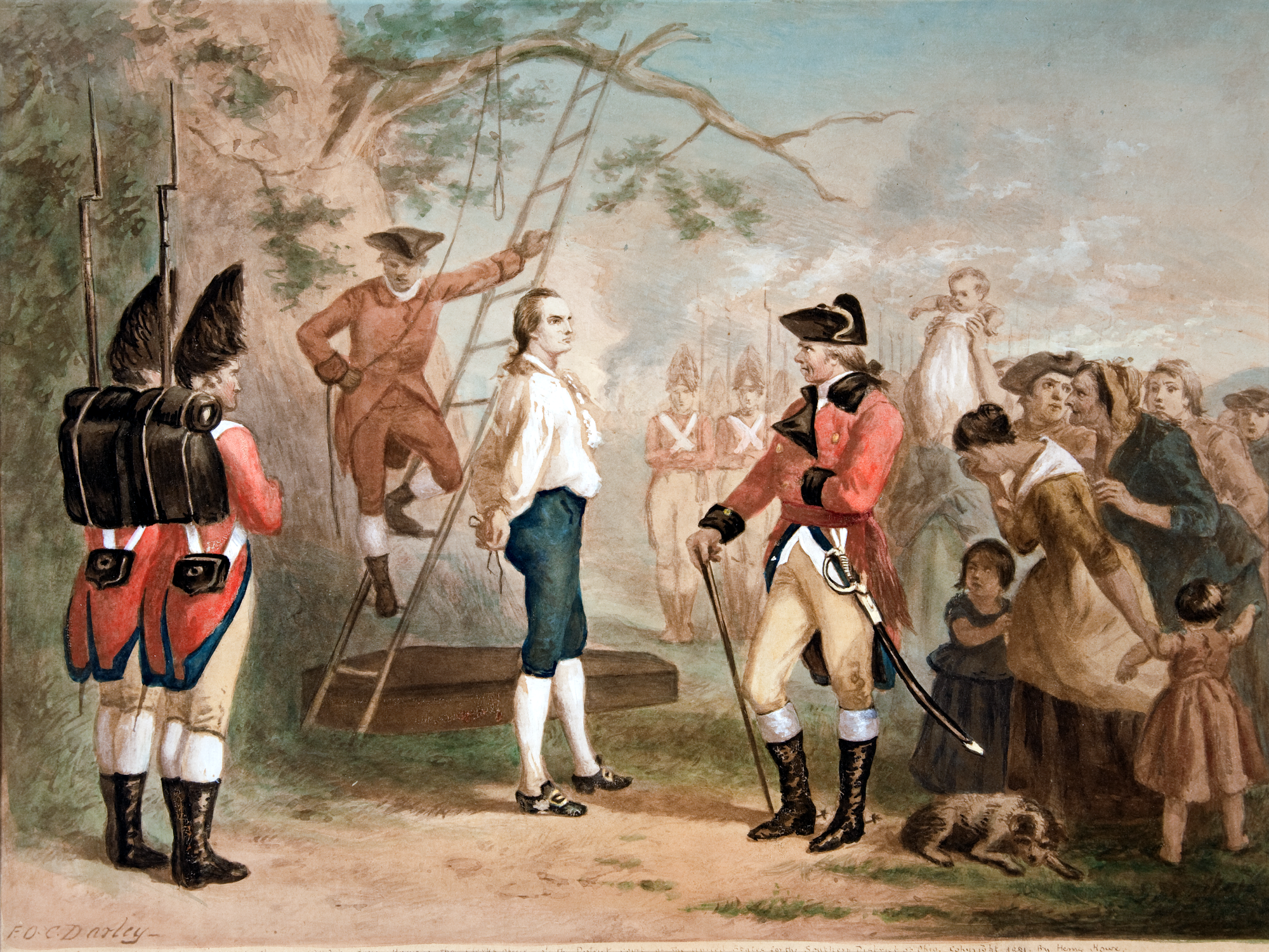
“The Life and Death of Nathan Hale” is Chapter Thirty-Two in Eric Metaxas’s new book REVOLUTION: The Birth of the Greatest Nation in the History of the World, available now.
My only regret is that I have but one life to give for my country.
—Nathan Hale
Now is the time for heroes… for great men to immortalize their names in the deliverance of their country, and grace the annals of America with their glorious deeds.
—James Hillhouse to Nathan Hale
Just outside the 1753 brick building at Yale where he lived as a student stands the statue of a young man dressed in Revolutionary garb. It is by the Connecticut sculptor Bela Lyon Pratt, and was commissioned in 1913. The figure has an inescapably noble bearing. When you look closely you see that his hands are tied behind his back, and that his feet are tied, too, because the sculptor has captured that sacred moment just before the twenty-one-year-old stepped into eternity.
Nathan Hale entered Yale at age fourteen and graduated four years later, in 1773. There are few figures from history in whom innocence, piety, and courage combine as they did in him. Perhaps Joan of Arc comes closest. But because we have lived in an age in which these qualities have fallen out of cultural favor, we may find such earnestness hard to take and think Hale too good to be true, such that we must hold him at arm’s length [FOOT NOTE: In a quintessentially painful example of this, the Yale Class of 1975 for their 40th reunion created “whimsical” bobble-heads of the statue, complete with the bound hands and feet, as though the figure of a young man hanged for his country could reasonably be treated with sophisticated archness.]. Everywhere Nathan went he seems to have dramatically impressed those around him. This is so widespread and notable that it cannot all be mere hagiography. A Yale classmate wrote: “No young man of his years put forth a fairer promise of future usefulness and celebrity. The fortunes of none were fostered more sincerely by the generous good wishes of his superiors.”
Nathan’s father sent both of his sons to Yale in 1769. Nathan’s brother Enoch was sixteen. Shortly thereafter, their father wrote them that he would “by all means desire you to mind your studies and carefully attend to orders of College. Attend not only prayers in the chapel but Secret Prayer carefully. Shun all vice, especially card playing. Read your Bibles a chapter a night and morning…” During college Hale was a member of a secret literary fraternity, Linonia, in which science, theology, and other subjects were debated. “What is the Reason that the Moon is not always Eclipsed every Opposition of the Sun and Moon?” was the subject of one week’s discussion. At Linonia he made a number of friends, all of whom seemed to share his sincere Christian faith, the closest being Benjamin Tallmadge. In the letters they exchanged after graduation—which are usually filled with playful joking—they signed their names as “Damon” and “Pythias.” [FOOT NOTE: The ancient Greek legend of Damon and Pythias—popularized by Cicero—illustrated the noble Pythagorean ideal of male friendship and loyalty.]
One of Hale’s mentors at Yale, Dr. Eneas Munson, said that his “personal beauty and grace of manner were most charming . . . all the girls in New Haven were in love with him.” One day, just after Hale left their house, Munson told his children, “That man is a diamond of the first water, calculated to excel in any situation he assumes. He is a gentleman and scholar—and last though not least of his qualifications, a Christian.” Hale stood six feet tall, quite tall for that time, and was renowned while at Yale for his strength and general athleticism, often winning in wrestling contests. His record long jump on the New Haven Green was “preserved” and “pointed out” well into the nineteenth century.
After Yale, Hale became a schoolmaster in the backwater village of Moodus, or Haddam Landing, on the Connecticut River, where he cultivated a relationship with a young woman that was cut short when he accepted a post in the more cosmopolitan town of New London, thirty miles away. The poem he wrote her following his departure includes the stanza:
You thought, no doubt, I took my leave last Night,
But tis not so. You [haven’t] come off so bright.
It’s true I said good-bye, but notwithstanding,
I only took my leave of Haddam Landing.
As a schoolmaster, he taught students the classics and theology, as well as Greek, Latin, and Hebrew. One of his students later recalled Hale’s extraordinary charm and personal magnetism. “Everyone who knew Hale was attached to him—that’s the fact.”
Another Yale friend, James Hillhouse, was the first to exhort him to serve his country. In a letter from July 1774, he wrote: “Liberty is our reigning topic, which loudly calls upon everyone to exert his talents & abilities to the utmost in defending of it.” The next lines seem prophetic: “Now is the time for heroes. Now is the time for great men to immortalize their names in the deliverance of their country, and grace the annals of America with their glorious deeds.”
On the afternoon of April 22nd, 1775, word of the events at Lexington and Concord reached New London, and at a town meeting that night, Hale rose to speak, saying he wanted to march north to Boston, and join the fight. “Let us march immediately,” he said, “and never lay down our arms until we obtain our independence.” For someone at this early juncture to speak of independence was genuinely startling. Scholars reckon Hale’s statement to be the very first time anyone had done so publicly. He seemed to appreciate what was at stake before almost anyone else. Because he was so deeply respected in New London, his words carried great weight. Elizabeth Poole, who at that time lived in the same boarding house, remembered that parents and pupils both greatly appreciated his “capacity as a teacher, and the mildness of his mode of instruction.” His “appearance, manners, and temper secured the purest affections of those to whom he was known.” Poole went on to describe him as “free from the shadow of guile,” and said that no “species of deception had any lurking place in his frank, open, meek & pious mind; his soul disdained disguise.”
Rather than immediately ride to Boston as part of a militia that April, Hale chose to do something more formal: he would join Washington’s Continental Army. Nor did he like the idea of abandoning his important position as schoolmaster in the middle of the term. Meanwhile, he corresponded with two Yale classmates, Ezra Selden—who was already serving near Boston and saw the carnage of the Battle of Bunker Hill—and Benjamin Tallmadge, who first encouraged him not merely to be a member of the militia, but to join Washington’s Army. “When I consider our country,” Tallmadge wrote him, “a land flowing as it were with milk & honey, holding open her arms & demanding assistance from all who can assist in her sore distress, methinks a Christian’s counsel must favor the latter… Our holy religion, the honor of our God, a glorious country & happy constitution is what we have to defend… We should all be ready to step forth in the common cause.” Hale agreed and that July enlisted, becoming a lieutenant in Connecticut’s Seventh Regiment. To his brother Richard, he wrote, “A sense of duty urged me to sacrifice everything for my country.”
His regiment did not march to Boston until September, but in the meantime, he recruited others to join him—they would end up with seventy-four in all—and drilled those already under his command. On September 1st, Hale was promoted to captain, second-in-command. During this time, he continued to impress those around him. A fellow officer predicted a bright future for the twenty-year-old, saying, “His mental powers seemed to be above the common sort, his mind of a sedate and sober cast, and he was undoubtedly pious.” Hale often had a Bible in his hand when visiting ill soldiers, praying aloud for their recovery. Hale’s regiment arrived in Cambridge in late September. The long stand-off with the British was just two months old. There were rare engagements. In a surprise attack, two of Hale’s men were killed and six wounded. But mostly over the weeks and months there was boredom, such that Hale organized wrestling matches between regiments—for which he was reprimanded. The dwindling food supplies became an issue of grave concern too. One day Nathan found himself talking to the legendary General Israel Putnam, explaining to him that many of his men feared starving to death. At one point twenty of those under him attempted to desert. Hale managed to get them all to promise to stay until the end of the year.
After the British left Boston, Hale marched with his regiment to New York, but his frustration at not yet having had the opportunity to serve his country in any meaningful way continued. Because we typically only hear of the more important actions of any war, we often get the impression these were all that happened. For example, while nothing terribly significant was happening in New York, a number of small actions were taken, as when a number of the men in Hale’s unit joined an effort to set fire to two of the British ships in the Hudson, the Phoenix and Rose, which after having boldly sailed past the American batteries on July 12th—as aforementioned—ended up near Tarrytown, and because of the winds stayed there. In the black of night, Hale’s men and some others rowed in galleys to sneak alongside these vessels, while towing a boat loaded with flammable materials and explosives. Although they did not succeed in setting fire to the venerable warships, their attempt caused tremendous consternation among the British, such that Washington commended everyone involved.
One early example of Hale’s bravery took place in May of 1776. Although the British fleet arrived en masse in New York that July, there were already some British ships there, among them the sixty-four-gun HMS Asia. Hale was stationed on Long Island at this time, and knowing the Americans were in desperate need of supplies, devised a daring plan to sneak out under cover of darkness to the supply sloop that was anchored next to the Asia and capture it. He didn’t tell his commanding officers of the daring mission, fearing they would forbid him from it. So with a few men from his unit, Hale one night crept down to the water and waited in the dark. When the men in the sloop went to sleep, Hale’s plan was to sneak onto the ship, unmoor it, and then guide it quietly to the American side. When the man guarding the sloop at last said “All’s well!” and went below, Hale knew it was time, soon after creeping board the vessel, and successfully guiding her to the wharf. It was a heroic effort, widely celebrated by the Americans.
By August, everyone in New York knew the all-out British attack must come soon. Nathan wrote his brother that it was an “event we leave to Heaven” and thanked God the Americans had had sufficient time to prepare their fortifications. But when at last the British attacked and the Battle of Brooklyn was fought, Hale’s unit was in Manhattan, out of harm’s way, and he again missed the opportunity to do something significant for his country.
Following the Battle of Brooklyn, Washington was at a loss what to do, having no idea what Howe was thinking. He needed an intelligence network of spies, men willing to risk their lives for the cause of freedom, and that summer had named Thomas Knowlton to head up what would be called Knowlton’s Rangers. Hale was already known both for his intelligence and his tremendous zeal to serve his country, and likely also because of the derring-do and initiative he had shown in his raid on the sloop that May, he was chosen for this secret elite group. On September 8th, desperate for intelligence of Howe’s plans, Washington asked Knowlton if there was anyone who would accept the extremely dangerous assignment of slipping behind enemy lines as a spy. Knowlton first chose a soldier named James Sprague. But Sprague refused to go, citing the typical belief of soldiers at that time, that doing the work of a spy was fundamentally dishonorable. It broke every rule of warfare, requiring the spy to engage in a disagreeable level of deception, so that spies were thought no better than scoundrels, and if captured, would be hanged immediately.
Knowlton called a meeting of his rangers, hoping one of them would volunteer for the mission. Hale had been quite ill with influenza and was not there, but in the middle of the meeting, he suddenly appeared, and before long had volunteered, shocking the other men, who tried to talk him out of it. But Hale was resolute. “I think I owe to my country the accomplishment of an object so important,” he said, “and so much desired by the commander of her armies—and I know of no other mode of obtaining the information, than by assuming a disguise and posing into the enemy’s camp.” It stood to reason that if Washington—whom he respected more than any alive—longed for someone to render this service, it would be no disgrace, but an honor, and the opportunity would satisfy Hale’s longing to give himself fully to the sacred cause. Hale does not seem to have feared death, and despised the idea of acting fearfully, or merely in his own interests rather than that of the country. “I am fully sensible of the consequences of discovery and capture in such a situation,” he said, “but for a year I have been attached to the army and have not rendered any material services while receiving compensation for which I make no return.”
After the meeting he found his old Yale friend, William Hull, who also tried to talk him out of it. Hull felt Hale lacked the cunning necessary for such a mission, later saying “his nature was too frank and open [for] deceit and disguise.” Then there was the moral question. Hull called the “propriety” of being a spy “doubtful,” echoing the widely shared opinion. “Who,” he asked Hale, “respects the character of a spy, assuming the garb of friendship but to betray?” In other words, it meant lying. Did not the Scriptures clearly forbid that? But Hale would have thought more deeply about it than Hull: did not the Scriptures countenance Rahab’s deception in helping Joshua and his men take Jericho?
Hull’s view was typical for the time: soldiers should “do our duty in the field; contend for our legitimate rights, and not strain the honor by the sacrifice of integrity.” He counseled Hale that “when present events, with all their deep and exciting interests, shall have passed away, may the blush of shame never arise, but the remembrance of an unworthy, though successful act, in the performance of which we were deceived by the belief that it was sanctified by its object.” In other words, could the ends ever justify such mean means? He obviously didn’t think so. Hull persisted. “Does your country demand the moral degradation of her sons,” he asked, “to advance her interests?”
But Hale had considered these objections. “I am not influenced by the expectation of promotion or pecuniary reward,” he explained. “I wish to be useful, and every kind of service necessary to the public good, becomes honorable by being necessary.” For him it was another kind of honor. “If the exigencies of my country demand a peculiar service,” he said, “its claims to perform that service are imperious.”
So Hale’s faith seems to have pushed him beyond the typical desire for recognition and battlefield honors. The greatest honor would be to serve the sacred cause by serving Washington, who embodied honor and dignity. On another level, Hale’s faith suggests that he longed to follow in the footsteps of the one he wished to serve above even Washington, who “made himself of no reputation, taking on the form of a servant…” Had not Jesus himself abased himself? Most of the less pious young men could not fathom his reasoning, but by this time Hale had made his decision.
For context, we recall the great desperation of the American forces at this time. Manhattan was essentially surrounded by scores of British ships, with thirty thousand men. The British might at any moment crush them, ending the glorious cause. The advantage of any intelligence cannot be overstated, and Nathan hoped he might be the means of obtaining it. It seems that Hale met with Washington before he left, so that Washington could personally communicate what intelligence he hoped Hale might procure. But because of the nature of the meeting, no record was kept. Nathan’s boyhood friend Asher Wright from Coventry had joined Hale’s regiment and served as his orderly at this time. Wright—who to the end of his life at age ninety would refer to Hale as “the praying man” and weep whenever mentioning him—was the last friend to see Hale, shaving and clothing him before he departed on his fateful mission. Hale also entrusted his belongings to Wright’s care, lest he fail to return.
The plan was for Hale to assume the disguise of a Connecticut soldier heading home, looking for work as a schoolmaster. He wore a white linen frock and carried his Yale diploma as proof of his credentials. With another soldier and friend, Stephen Hempstead, he would travel on foot up the coast into Connecticut. Once they reached Norwalk, Hale would get a boat across the Sound to Long Island, at which point he would be in enemy territory. He would then make his way back down toward New York. There was something about Hale’s good looks and athleticism that made him seem invincible to many, but when Asher months later learned of Hale’s mission, he felt that Hale’s noble bearing was sure to make him stand out, saying it would have been wiser to choose “some scrubby fellow.”
Another problem was that Hale had the obvious scar of a “powder flash” on his face, which could have betrayed him as having been a soldier. When a gun misfired, the powder was sometimes burned into the face, having a tattoo-like effect.
So with Hempstead he made his way to Norwalk, where Hale donned his full Dutch “schoolmaster” guise, getting rid of the silver buckles on his shoes and wearing a brown jacket and “broad-brimmed” hat. He gave his uniform and papers to Hempstead, who would remain in Norwalk, awaiting Hale’s return. Historians have long puzzled over his carrying the diploma with his own name on it. Early on the morning of the sixteenth, Hale took the sloop Schuyler across the Sound to Huntington, where on foot he began his journey toward Brooklyn, probably arriving on the eighteenth. From there he took a ferry across to the base of Manhattan, where he began doing what he had traveled all this way to do, sketching the fortifications he saw, and making notes of anything he thought Washington would find valuable.
On September 20th—ostensibly having completed his mission—Hale took a ferry back across to Brooklyn and was walking the forty miles back to Huntington, Long Island. That night somewhere along the way he stayed at a tavern, planning to take a ship back to Connecticut in the morning. But before that could happen, the man whom so many thought notable for his principles, innocence, and guilelessness was taken in by someone equally notable for his lack of principle, moral maculation, and guile. This was Robert Rogers, a truly vicious figure whom one of his men described as possessed of an evil “as deep as hell itself,” and who was known for his brutality and ruthlessness. Rogers had the rare distinction of being reviled by British and American leaders both. In a letter, Thomas Gage said he was “wild, vain, of little understanding, and of as little principle,” and possessed of “cunning, [and] no modesty or veracity.” Gage also said he “made a great deal of money during the [French and Indian] war, which was squandered in vanity and gaming,” which had put him “some thousands in debt.” After Lexington and Concord, Rogers went to Boston to see whether Washington might want his services. But by now he had added alcoholism and a reputation for general licentiousness to his resume. Washington, regarding him as deceptive and repugnant, declined the offer. But the British, who had no qualms about using someone’s moral failings to their own advantage, happily gave Rogers the command of a Loyalist unit on Long Island. It was in this capacity that he bumped into Nathan Hale in the tavern that night.
Hale fell into conversation with Rogers, believing the dark figure’s story that he was himself on the patriots’ side, and the next morning foolishly revealed his own leanings, stumbling into Rogers’s trap [FOOT NOTE: The oft-told story that Hale was identified by a Tory cousin, Samuel Hale, seems highly unlikely]. Rogers had Hale arrested, bound hand and foot. On the morning of the twenty-first, he was placed in the brig of the Halifax, which sailed westward to Manhattan, arriving some time that afternoon.
Upon arrival, Hale was delivered to the headquarters of General Howe himself, at the Beekman mansion, near what is today East Fifty-First Street. Hale had by this time forsworn any pretense of being anyone other than who he was. The maps and sketches he made had been discovered. He freely admitted his name and mission, and knowing what lay in store for him, had resigned himself to his fate with the equanimity we would expect. A British soldier who was present remarked that “the frankness, the manly bearing, and the evident disinterested patriotism of the handsome young prisoner sensibly touched a tender chord of General Howe’s nature.” But as a man under authority himself, Howe was helpless to do anything beyond what the fixed rules of the situation demanded, which was to pronounce a sentence of death by hanging. It is an extraordinary and affecting scene in history, the noble young soul in his humble costume standing before the world-weary Howe in his general’s uniform. We assume Howe relished this interview with his prisoner as little as Pilate did his own so many centuries before. There was no crowd in front of whom to wash his hands before he did his unpleasant duty. The execution would take place the next day. He then turned Hale over to the Provost Marshall, William Cunningham, so notorious for his barbarism that he became regarded as the most hated man in America. The greenhouse on the Beekman Estate served as a temporary jail, into which Cunningham put Hale for the night, with two armed guards. At some point, Hale asked Cunningham for the presence of a chaplain, which Cunningham denied. Hale then reportedly asked for a Bible, which Cunningham also denied. His reputation would lead us to believe that he enjoyed doing so.
That night, Captain John Montresor, who served as Howe’s chief engineer, was asked to look at Hale’s drawings, maps, and notes—likely written in Latin. On the morning of September 22nd, Hale was marched or conveyed about three-quarters of a mile northwest to an artillery park in the vicinity of what is today Sixty-Sixth Street and Third Avenue. Montresor’s marquis tent was near, and he was allowed to graciously “offer Hale the protection of his tent,” while Cunningham made preparations for the execution. Hale asked Montresor if he would let him write two letters. Montresor knew Cunningham would not approve and so hurriedly provided quill, ink, and paper. Hale wrote his brother Enoch and then Captain Knowlton, unaware that Knowlton had been killed a few days earlier during the fighting in Harlem Heights. Montresor said that Hale was “calm, and bore himself with gentle dignity, in the consciousness of rectitude and high intentions.”
British lieutenant Frederick Mackenzie, who was present, wrote in his diary that Hale was hanged at eleven in the morning, and “behaved with great composure and resolution,” and wrote that Hale said he believed “it the duty of every good officer, to obey any orders given him by his Commander-in-Chief,” and that he “desired the spectators to be at all times prepared to meet death in whatever shape it might appear.”
It seems that Hale’s final words before he was hanged—“My only regret is that I have but one life to give for my country”—were an intentional echo of the lines from the popular play Cato by Joseph Addison. There are various versions of what Hale said. The lines from Addison’s play are:
How beautiful is death, when earn’d by virtue!
Who would not be that youth? What pity is it
That we can die but once to serve our country.
The first account of Hale’s fate was published in New England’s Essex Journal four months later. It reported his final words as: “You are shedding the blood of the innocent. If I had a thousand lives, I would lay them all down, if called to do it, in defense of my injured, bleeding country.” The details of how a monster such as Cunningham would have treated Hale’s execution are unimportant but may be guessed at when we consider how his body was treated. It was allowed to hang from the tree for three days, during which time many British soldiers desecrated it, as was the custom, even attaching to it cartoons mocking Washington. Hale’s body was buried nearby in an unmarked grave. Montresor gave Hale’s two final letters to Cunningham, who destroyed them, reportedly saying, “The rebels should never know they had a man who could die with so much firmness.”
Nathan’s brother Ethan sought information on his younger brother for weeks, finally learning the news on October 23rd in White Plains from Colonel Charles Webb, the head of Nathan’s unit. Webb had heard the news from Montresor himself, who on the day after Hale’s death had under a white flag crossed over into enemy lines to meet with Joseph Reed, Israel Putnam, and Alexander Hamilton to give them a letter from Howe to Washington, concerning a prisoner exchange. And so in this way the difficult news had been confirmed.
Just a few months after Nathan’s death his father, Richard, wrote a letter to his own brother, Samuel, in Portsmouth, New Hampshire. “Dear Brother,” he said,
I received your favor of the 17th of February last and rejoice to
hear that you and your family are well. Your observation as to
the difficulty of the times is very just. So gloomy a day we never
saw before but I trust our cause is just and for our consolation
in the times of greatest distress we have this to support us—that
there is a God that judgeth in the earth if we can but take the
comfort of it. As to our being advanced in life . . . if it do but
serve to wean us from this present troublesome world and stir
us up to prepare for a world of peace and rest it is well… You
desired me to inform you about my son Nathan. You have
doubtless seen the Newburyport paper… He was executed
about the 22nd of September last, by the accounts we have had.
A child I sought much by, but he is gone… We are all through
the Divine Goodness well. My wife joins in love to you and to
Mrs. Hale and your children. Your loving brother, Richard.