
Trump’s New World Re-Order
October 23, 2026
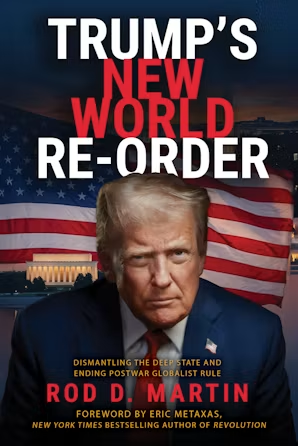
The latest release from Odysseus Books is Trump’s New World Re-Order: Dismantling the Deep State and Ending Postwar Globalist Rule by Rod D. Martin. Available now.
* *
INTRODUCTION
Almost everyone misunderstands Donald Trump—including many who love him.
They mistake his style for his strategy. His style is improvisational, combative, theatrical, and deliberately unpredictable. His strategy is systematic. What looks from day to day like a jumble of tariffs, deportations, firings, trade threats, alliance demands, energy orders, court fights, anticorruption investigations, and technological moonshots is one comprehensive project.
Trump is not merely changing policies he dislikes. He is dismantling an entire order and building another.
At home, he is dismantling the unaccountable technocratic state Franklin Roosevelt built in place of our constitutional system: the permanent govern-ment of “independent” agencies, credentialed “experts,” judges, NGOs, intel-ligence operatives, and bureaucrats who continue to rule regardless of whom the people elect. Abroad, he is replacing the globalist system Roosevelt’s generation built for the world of 1945: a system in which America carries the burdens, subsidizes its allies, tolerates mercantilism, dilutes its power through multilateral institutions, and is told that serving its own citizens is not only corrupt but shameful.
Those two projects are not separate. They are of a piece: one restoration of sovereignty at two different scales. At home, elections have to matter. Abroad, nations have to matter—and American power has to serve the American people.
This is not a claim that every Trump move is flawless, every appointment wise, or every tactic scripted years in advance (though a great many of them are). A comprehensive strategy is not a screenplay. Chess requires adaptation; poker requires bluffing; governing requires both. Trump has made mistakes, especially in his first term, when he was an outsider surrounded by men who understood Washington better than he did and often served interests other than his.
But the Trump who returned in 2025 was not the Trump who arrived in 2017. He had spent four years learning who was who, what was what, and how the permanent government defeats elected presidents. He had fought the Balrog of the state and returned as Gandalf the White.
Most of his supporters still do not see the scope of what he is doing. They see issues they like: the border, tariffs, drilling, NATO burden-sharing, China, DOGE, Golden Dome. They say he is “good on a lot of things.” They do not see how those things fit together. They see the knight, the rook, and the pawn. They do not see the whole board.
Trump does—with the intense attention to how every detail shapes and serves the whole that one would expect from a wildly successful luxury real-estate developer. As in his early years in that business, his first term was his apprenticeship. He returned as the master.
He also plays poker. His public unpredictability is often the means by which he gains leverage, forces movement, and keeps opponents from coor-dinating against him. The press calls that chaos because it examines each hand in isolation. Washington calls it ignorance because its experts cannot imagine a strategy they did not design. Yet again and again, what looked like an outburst, a threat, or an impossible demand turns out to have been the opening bid in a larger negotiation.
Geopolitics, like generations, is in many respects shaped by impersonal forces. But history is entirely personal. It is subject to a personal God, and it is repeatedly redirected by particular men: Alexander and Caesar, Washington and Lincoln, Roosevelt and Reagan. There are moments when institutions are exhausted, consensus has failed, and the future turns on whether one man can see what others cannot—and endure what others will not.
That last point matters. The system Trump is attacking was built to absorb ordinary political opposition. It can slow a normal president, flatter him, iso-late him, capture his appointees, wait him out, and then resume its work. It could not be overthrown by a cautious caretaker of decline.
So they tried to break Trump. They investigated him, impeached him, censored him, raided his home, prosecuted him, threatened him with prison, tried to bankrupt him, attacked his family, and sought to make an example of everyone around him. They even tried to kill him.
And yet he stands.
This is not incidental to the argument of this book. Trump’s refusal to quit is one of the indispensable facts of our era. Most men would have retired to wealth, comfort, applause, and memoirs. Trump came back bloodied, better prepared, and more determined. He did not have to do this. He chose to do it. Whatever else one thinks of him, that endurance, that tenacity, deserves respect—and it explains why a project of this magnitude is possible at all.
The order Trump confronts is older and deeper than most Americans
understand. Augustus kept the Senate, the elections, and the forms of the Roman Republic. But he fundamentally changed their substance. In much the same way, the American constitutional forms survived the New Deal while power migrated to a permanent, unelected ruling class. Presidents came and went. Congress changed hands. The machinery remained.
Franklin Roosevelt did not merely enact a collection of programs. He founded an era. He built the domestic architecture of technocratic government and helped create the international order that his successors completed after the war. For good and ill, we have lived in FDR’s world ever since.
Trump is the counter-FDR. His object is not to manage Roosevelt’s inheri-tance more competently. It is to end it: to restore the constitutional authority of the elected branches, return power to the people and the states, rebuild American industry and energy abundance, replace dependency with partner-ship, reassert control over the approaches to North America and the world’s strategic chokepoints, preserve dollar dominance, constrain and perhaps collapse the Chinese Communist Party, and open a new technological frontier in artificial intelligence, missile defense, robotics, nuclear power, and space.
Virtually no one believes all of this is one project. That is precisely why this book is necessary.
This is not a biography of Donald Trump, nor a catalogue of his policies. It is a map of the unfolding counterrevolution. It provides the missing historical frame, conveys the enormity of the change now underway, and tours the many fronts on which one vision is being executed. The Deep State, the border, the courts, tariffs, energy, the dollar, NATO, the Middle East, Russia, China, Golden Dome, and the new space economy are not disconnected subjects. They are mutually reinforcing parts of a new American-led order.
By the end, I intend for you to see the whole board—and to understand why every knight, rook, and pawn is precisely where it is.
Donald Trump is not just some chaos agent smashing a status quo he dis-likes. He is the architect of a new era: restoring a Republic rooted in its found-ing documents at home, and building an America-centric order abroad capable of carrying freedom, prosperity, and peace through the rest of this century.
The old “New World Order” is ending. Trump’s re-ordering has begun.