
Adams and Franklin Share a Bed
May 22, 2026
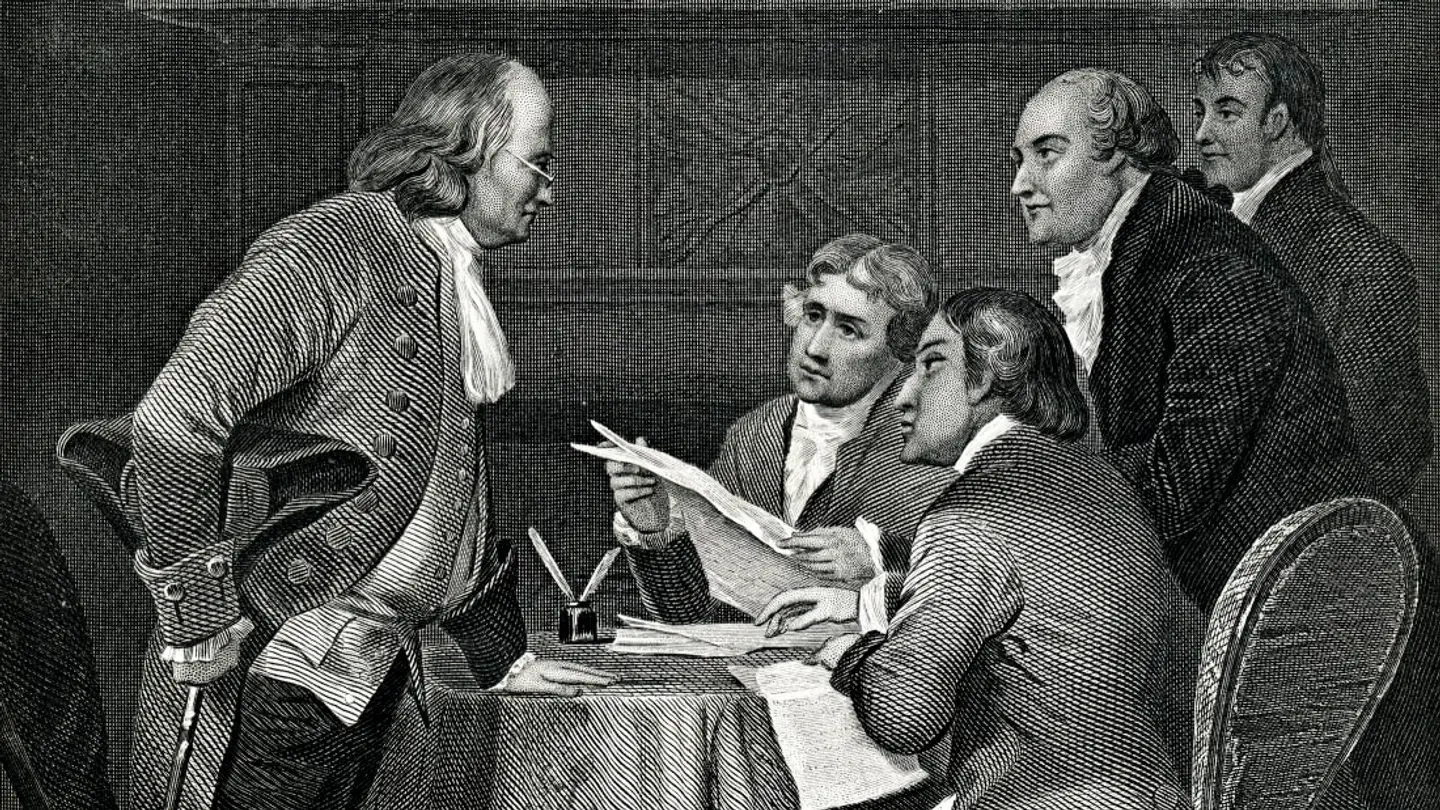
This excerpt is from Eric Metaxas’s new book REVOLUTION: The Birth of the Greatest Nation in the History of the World, available now!
In considering the relationship between John Adams and Benjamin Franklin, it is sometimes tempting to regard them as some species of eighteenth-century odd couple, with Adams playing the more pinched, parochial, and easily upset Felix Unger, and Franklin the more rumpled, broad-minded, and easy-going Oscar Madison. So the prospect of these historic characters lying down together in a single bed for one chilly September night in 1776 presents a scene difficult to ignore.
The two men began life similarly, both born in Boston, albeit twenty-nine years apart. Their fathers were both devoutly Christian tradesmen—Franklin’s made candles and soap and Adams’s shoes—and both had Puritan roots, although Franklin had over the decades cut various capers in other directions, sneaking away from Boston for the more worldly environs of Philadelphia at seventeen, becoming a man of the world in every sense, siring at least one illegitimate son and spending most of the previous eighteen years in England, apart from his wife. For his scientific and other accomplishments he had become more celebrated than nearly anyone on the planet. But the sometimes-irascible John Adams was not always as impressed with his venerable colleague as some others, and the two could clash from time to time, especially in Paris a few years in the future, when they were both there as diplomats.
Because of the many soldiers along their route, the inns were generally full. When on their second night the trio stopped in New Brunswick, Adams recalled that “but one bed could be procured for Dr. Franklin and me, in a Chamber little larger than the bed, without a Chimney and with only one small Window.” If not for Adams’s firsthand account, we might be expected to dismiss the domestic scene of these Founding Fathers sharing a small bed as obviously legendary. But Adams even gives us the details of their dispute about whether to close the window. The humility of these giants in sharing such accommodations in such markedly close quarters in the cause of their fledgling nation is at least remarkable. As for the window, Adams quickly shut it, fearing the cold night air would make him ill. But Franklin was staunchly of another opinion. “Oh! Don’t shut the window,” he implored, “We shall be suffocated.”
The scientific Franklin went on, explaining that the “air within this chamber will soon be, and indeed is now worse than that without doors. Come! Open the window and come to bed, and I will convince you: I believe you are not acquainted with my Theory of Colds.” As it happened, Adams was quite familiar with it, and dutifully complied with his bed partner’s request, reopening the window and then joining Franklin in the bed, as they continued the conversation.
Adams admitted to Franklin that he had indeed read Franklin’s “Letters to Dr. Cooper” on the subject at hand, in which Franklin claimed that no one actually caught a cold from cold air. But Adams said that since this was inconsistent with his own observations, he had dismissed Franklin’s thesis as “a paradox.” Nonetheless, with the celebrated scientist lying next to him, Adams thought it an extraordinary opportunity to hear him expound further on the subject. “I had so much curiosity to hear his reasons,” Adams said, “that I would run the risque of a cold.”
“The Doctor,” Adams remembered, “then began an harangue, upon Air and cold and Respiration and Perspiration…” Adams claimed to recall “little of the lecture…except, that the human Body, by Respiration and Perspiration, destroys a gallon of Air in a minute: that two such Persons, as were now in that Chamber, would consume all the Air in it, in an hour or two: that by breathing over again the matter thrown off, by the Lungs and the Skin, we should imbibe the real Cause of Colds, not from abroad but from within.” But as Franklin in the darkness chattily continued to fill the small room with his great learning, Morpheus cast his spell. “I soon fell asleep,” Adams said, “and left him and his Philosophy together.”